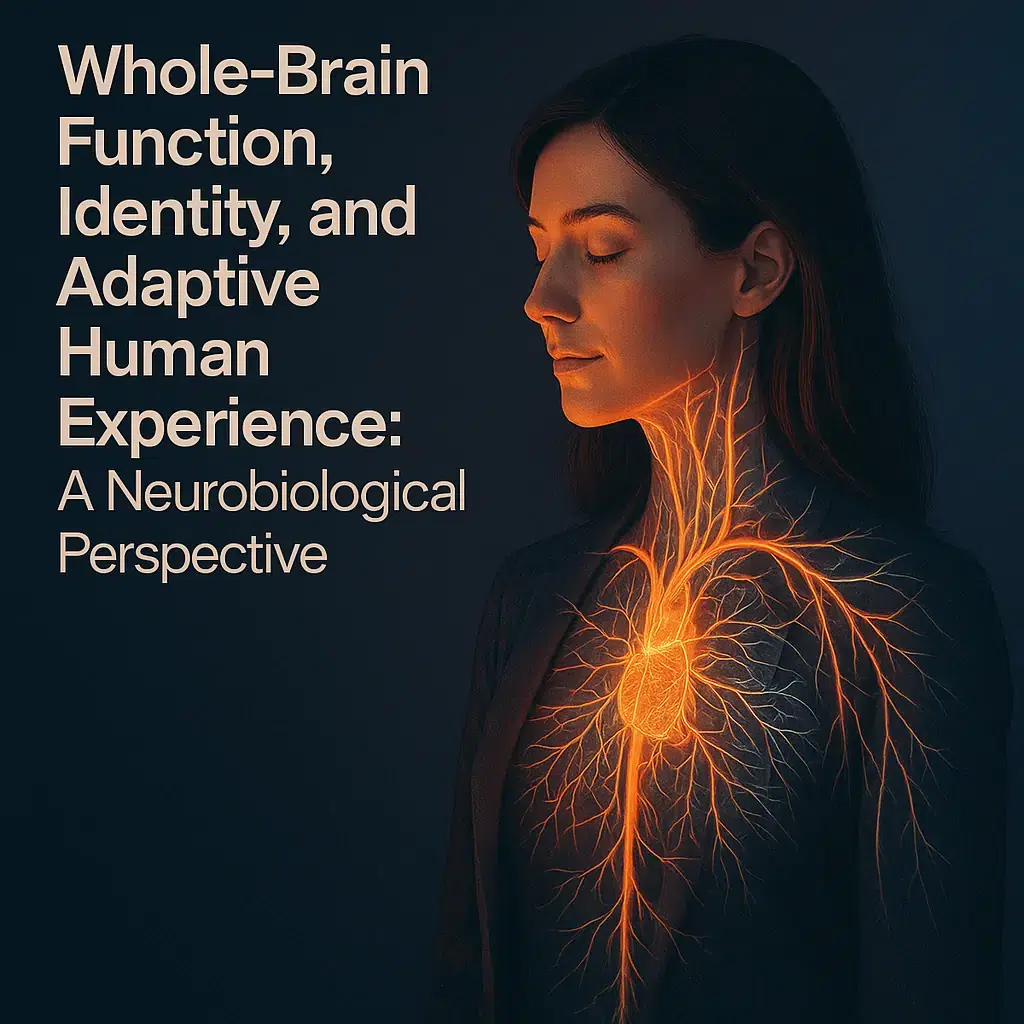
Modern leadership culture has quietly conditioned high-performing individuals particularly women to succeed through contraction rather than expansion. It has rewarded analytical sharpness, emotional suppression, and high cognitive output while undervaluing the biology that sustains human performance in the first place. The common belief that mental strength and discipline alone determine success has created an environment where individuals can achieve remarkable external accomplishments while feeling internally disconnected, fatigued, or unable to access a deeper sense of fulfillment and ease. This is not because they lack ambition or resilience; it is because the nervous system was never designed to operate solely through cognitive pathways. Leadership built on tension ultimately collapses under its own weight; leadership built on capacity grows.
The traditional academic conversation around left- and right-brain function has often been oversimplified or misinterpreted. Neuroscience does not support the idea that individuals only use one side of the brain. Both hemispheres communicate constantly, and both are essential. However, what has been proven across research, fMRI studies, neuroanatomy, and behavioral neuroscience is that the two hemispheres contribute differently to human life and leadership. The left hemisphere creates linear sequencing, linguistic processing, structured planning, memory referencing, and identity continuity. It uses the past to predict and prevent threat. It is precise, task-oriented, and designed to maintain order and performance. This is the part of the brain that enables corporate systems to operate, complex deals to close, and strategic decisions to be made.
Yet it is not the whole of human intelligence and when over-recruited, it narrows perception, contracts emotional states, and increases physiological strain. Chronic activation of left-hemispheric circuits, particularly the networks tied to vigilance and emotional memory, strengthens internal patterns of caution, self-protection, and anticipatory stress. Leaders who have operated in high-stakes environments for extended periods frequently describe the same internal condition: a feeling of constantly managing, monitoring, calculating, and staying “ready.” They succeed outwardly, but inwardly they are bracing. That bracing often becomes so normalized that it is mistaken for personality, discipline, or drive. It is, more accurately, a nervous system trained to remain in readiness and a brain accustomed to holding past experience as a predictive map for the future.
In contrast, the right hemisphere provides a fundamentally different yet equally essential form of intelligence. While the left focuses on predictability and control, the right processes present-moment experience, emotional nuance, relational awareness, and internal sensing. It is the hemisphere that allows leaders to read human energy in a room, notice subtle shifts in tone or stress, and understand dynamics beyond spoken language. It provides creativity, insight generation, intuitive pattern recognition, and an ability to access states of openness and perspective that cannot emerge from pure cognition. This hemisphere does not operate on “future anxiety” or “past evaluation” but on immediate experience the embodied knowing that arises not from thinking, but from perceiving.
When individuals lose access to this system whether through cultural conditioning, chronic stress, trauma imprinting, over-identification with achievement, or the demands of modern performance environments they do not lose intelligence. They lose range. They lose the inner elasticity that allows them to adapt, imagine, regulate, and relate from grounded presence rather than protective reflex. In leadership, this often looks like high competence paired with internal rigidity, emotional fatigue, or reduced creativity. The leader remains functional, but their nervous system is working at a high metabolic cost. Over time, this translates into exhaustion, emotional disconnection, difficulties accessing intuition, or a sense of living through effort instead of ease.
Human beings do not break from weakness they break from prolonged contraction. The nervous system cannot remain in defensive posture forever without consequence. And for women who have historically been required to operate through masculine-dominant nervous system strategies structure, control, efficiency, suppression of emotional instincts, and self-protective independence the strain is even more pronounced. Their achievements are real, but so is the internal cost. The next evolution of leadership does not ask women to return to softness. It invites them to reclaim biological intelligence that allows strength to be expressed without fragmentation.
This is not a psychological shift it is a neurological one. Trauma research and affective neuroscience demonstrate that emotional memory is encoded in subcortical circuits that operate beneath conscious intention. These circuits are not “negative”; they are protective. They store experiences that once ensured survival fatigue patterns, caution, hyper-vigilance, self-reliance, the impulse to keep moving rather than slowing down enough to feel. Healing in this context does not mean erasing history or “fixing” emotions. It means redistributing neural dominance acknowledging protective circuits, allowing right-hemisphere presence to become available again, and teaching the body that safety can coexist with ambition, visibility, and expansion.
Neuroplasticity the brain’s capacity to reorganize becomes the mechanism for human evolution. It is activated not by force, but by conscious, repeated engagement with new patterns: slowing down without collapse, expressing emotion without loss of power, experiencing rest without guilt, and allowing intuition to inform strategy rather than threaten control. When leaders learn to shift from mental bracing into somatic presence, the brain recalibrates. Stress response pathways soften, executive functioning improves, relational clarity increases, and creativity resurfaces. What once felt like pressure becomes possibility. The system does not weaken it expands.
This is where somatic intelligence enters the leadership conversation not as a trend, but as a biological necessity. Human beings regulate emotion through movement, breath, internal sensation awareness, and relational attunement not through cognition alone. The nervous system does not release tension through thought. It completes stress cycles through the body. When leaders learn to integrate breathwork, interoceptive awareness, emotional literacy, and embodied processing into their daily regulation, their baseline capacity increases. They do not push harder; they carry more with less internal friction. Emotional bandwidth grows. Cognitive clarity sharpens. Relationships deepen. Creativity returns. And most importantly they lead from regulation, not survival.
In this frame, feminine leadership is not about gender. It is about access access to the full neural architecture that enables presence, intuition, relational intelligence, creativity, embodied confidence, and emotional range. When combined with structured thinking, discipline, and strategic capability, it becomes a form of leadership that is not only effective but sustainable. It does not collapse under pressure and does not fracture under responsibility. It does not perform strength it embodies it.
The next era of leadership will not be won by those who think more, force more, or optimize harder. It will be led by individuals who can stabilize their internal world while influencing the external one who can feel without being swallowed by emotion, think without disconnecting from the body, and operate from integrated brain-body intelligence. This is not theory; it is observable in neuroscience, organizational psychology, trauma research, and embodied leadership data emerging across global institutions.
A regulated nervous system is not soft it is structurally efficient. A whole-brain leader is not emotional they are perceptive, innovative, and relationally capable. And a woman who leads from biological intelligence rather than inherited pressure does not burn out she expands.
Trauma, Stress Circuits, and Identity Collapse in High Performers
In high-performing individuals, “trauma” rarely presents as chaos. It presents as precision, control, hyper-functionality, and achievement that outpaces emotional integration. The nervous system learns early that safety is earned through excellence, compliance, responsibility, or emotional self-containment. Over time, this adaptive pattern matures into a form of identity architecture: worth becomes tied to output, belonging becomes tied to performance, and self-protection becomes synonymous with independence. The individual becomes highly capable, deeply responsible, and often without ever naming it chronically braced.
Unlike acute trauma responses marked by shut-down or panic, high-achievement trauma rests in activation: constant forward motion, emotional compression, rapid problem-solving, and a cognitive state optimized for control rather than connection. These patterns are intelligent. They were historically necessary. Yet when capacity grows and life stabilizes externally, the inner system may still operate as though threat remains present. This is why many accomplished women report that even during moments of success, recognition, or stability, their body feels a low-grade contraction, vigilance, or hesitation to fully rest, receive support, or soften.
Identity collapse occurs when the left-hemisphere executive structures that once organized life ambition, discipline, and performance self — weaken due to emotional overload, burnout, betrayal, loss, or neurological disruption. The collapse is not a psychological failure but a neuronal fatigue point the brain reaches the limits of operating primarily through protective pathways. What follows is not emptiness; it is a temporary inability to use familiar self-structures to orient, plan, or move forward. Leaders describe this as feeling “like I don’t recognize myself,” “like nothing feels motivating anymore,” or “like I’m watching my life rather than living it.”
Traditional models treat this as depression or burnout. A somatic–neuroscience perspective sees it as identity reorganization: a forced interruption of habitual circuits that opens access to alternative neural pathways. When met with emotional support, body-based regulation, and mindful re-patterning, these periods catalyze profound transformation. The self that emerges is often more stable, relationally available, intuitive, and authentic than the high-functioning self that preceded it. Capacity expands not through reinforcement of old identity scaffolding but through integration of new neural availability presence, emotional fluidity, embodied boundaries, and grounded power.
Somatic Regulation Tools for Executive Nervous System Development
Nervous system expansion is not a mental exercise. The cortex cannot override survival physiology without somatic participation. Tools for high-level regulation must address both brain and body:
Breathwork increases vagal tone, interrupts sympathetic dominance, and teaches the system to experience activation without identifying with it.
Interoception — the ability to feel internal states trains leaders to sense regulation or dysregulation in real time, enabling proactive emotional navigation rather than reactive self-correction.
Somatic movement allows emotional completion through physical expression rather than purely rational processing. It dissolves muscular armor, reorganizes fascia-stored tension, and restores fluidity in motor-emotional circuits.
Micro-pauses and physiological stillness reestablish agency in moments of cognitive urgency, shifting control from survival circuitry to intentional executive function.
When practiced consistently, these techniques do not make leaders slower; they make them faster, clearer, and more precise because internal noise decreases. Emotional bandwidth increases. Creativity re-emerges. Decision-making accelerates. Relationships deepen. The system no longer wastes energy on internal containment; instead it reallocates capacity toward creation, innovation, and relational intelligence.
Feminine Intelligence in Leadership Through a Neuroscience Lens
Feminine leadership is often misunderstood as softness, emotionality, or nurturance. In neurobiological terms, it represents access to the right hemisphere and ventral vagal pathways presence, attunement, intuition, emotional resonance, nuance perception, and embodied awareness. It is not opposite to high performance; it is the nervous system architecture required for sustainable performance and relational influence.
Historically, women succeeded by over-recruiting masculine neural patterns: linear drive, cognitive dominance, emotional suppression, and self-protection. They entered systems built by left-brain values hierarchy, efficiency, independence, control and excelled by adapting their nervous systems to match.
This was a powerful adaptation. It was also costly.
The next era of leadership requires not abandoning structure, but integrating feminine neural intelligence into professional capacity. Leaders who regulate instead of armor, who access intuition alongside strategy, who lead from presence rather than pressure, create ecosystems of psychological safety and innovation the exact environments where complex problem-solving and exponential growth occur.
Feminine leadership is not sentimental. It is somatically intelligent, emotionally literate, neurologically integrated, and biologically efficient. It produces long-term outcomes because it aligns physiology with vision rather than asking the body to endure the journey while the mind drives alone.
Integration: The Evolution of High-Performing Women
True expansion arises when the nervous system is no longer organizing life around protection but around capacity and possibility. When executives and founders learn to shift from vigilance to presence, from intellectual strength to embodied strength, the internal architecture reorganizes. Ambition remains but it is fueled by coherence, not contraction.
A whole-brain, whole-body leader is not driven; she is directed.
She does not force; she receives and acts.
She does not operate from urgency; she operates from clarity.
In this state, life does not feel like something to carry it becomes something to inhabit.
This is not recovery.
It is evolution.
The Six Phases of Nervous System Evolution in High-Achieving Women
Phase 1: Functional Survival
You appear strong, competent, calm but inner tension drives achievement.
You are succeeding, not expanding.
Phase 2: Invisible Fatigue
Efficiency stays high, but emotional availability narrows.
Rest feels foreign, not restorative.
Phase 3: Identity Friction
You sense you can no longer lead from old internal architecture.
Not burnout evolution knocking.
Phase 4: Somatic Awakening
Breath, sensation, and nervous system awareness open new neural access.
Presence becomes a resource, not a threat.
Phase 5: Integration
Ambition remains, urgency dissolves.
You lead from groundedness instead of performance pressure.
Phase 6: Embodied Expansion
Capacity increases.
You hold more without tightening, without protecting, without losing yourself.
This is not emotional softness.
This is biological sophistication.
Daily Integration Practices for Whole-Brain, Embodied Leadership
1. Micro-Pause Protocol (30 seconds)
- Inhale through nose 4 seconds
- Exhale 6–8 seconds
- Drop attention from thinking → sensing (heart / belly)
- Ask: Am I acting from pressure or clarity?
This rewires executive function + emotional regulation.
2. Nervous System Capacity Training (5 minutes)
- Open chest / soft jaw / soften belly
- Slow nasal breathing
- Name sensation without changing it
- Allow emotion to move somatically (not mentally)
3. Embodied Boundary Check
Ask daily:
What am I holding that isn’t mine to carry?
Release through breath + physical shake or exhale movement.
4. Creative Brain Re-Activation
10 minutes daily of:
- Drawing
- Dancing
- Mind-wandering
- Silence without stimulus
This reactivates right-hemisphere curiosity + innovation.
5. Receiving Practice
Say yes to support in one small area daily.
Receiving is a nervous system skill, not a personality trait.
These practices are not routines they are repatterning tools.
You are not becoming softer.
You are becoming more electrically efficient, emotionally agile, and neurologically free.
The Future Belongs to Regulated Leadership
The next era of leadership will not reward the nervous system that tolerates the most stress but the one with the greatest capacity, presence, relational depth, and internal safety.
Whole-brain, whole-body, whole-self intelligence is not a luxury.
It is the new competitive advantage in life, business, and humanity.
This is not self-help.
This is adaptive neurobiology.
This is embodied feminine power.
This is where women evolve beyond surviving success into inhabiting it.
If you’re a high-achieving woman who senses your evolution has begun not because you’re breaking, but because you’re outgrowing old internal architecture this is the work I do.
To explore private Nervous System Energetics™ mentorship:
📎 Book your clarity call
https://calendly.com/marina-savic30/clarity-call?month=2025-11
We don’t just change behavior here
we expand capacity, identity, and internal power.