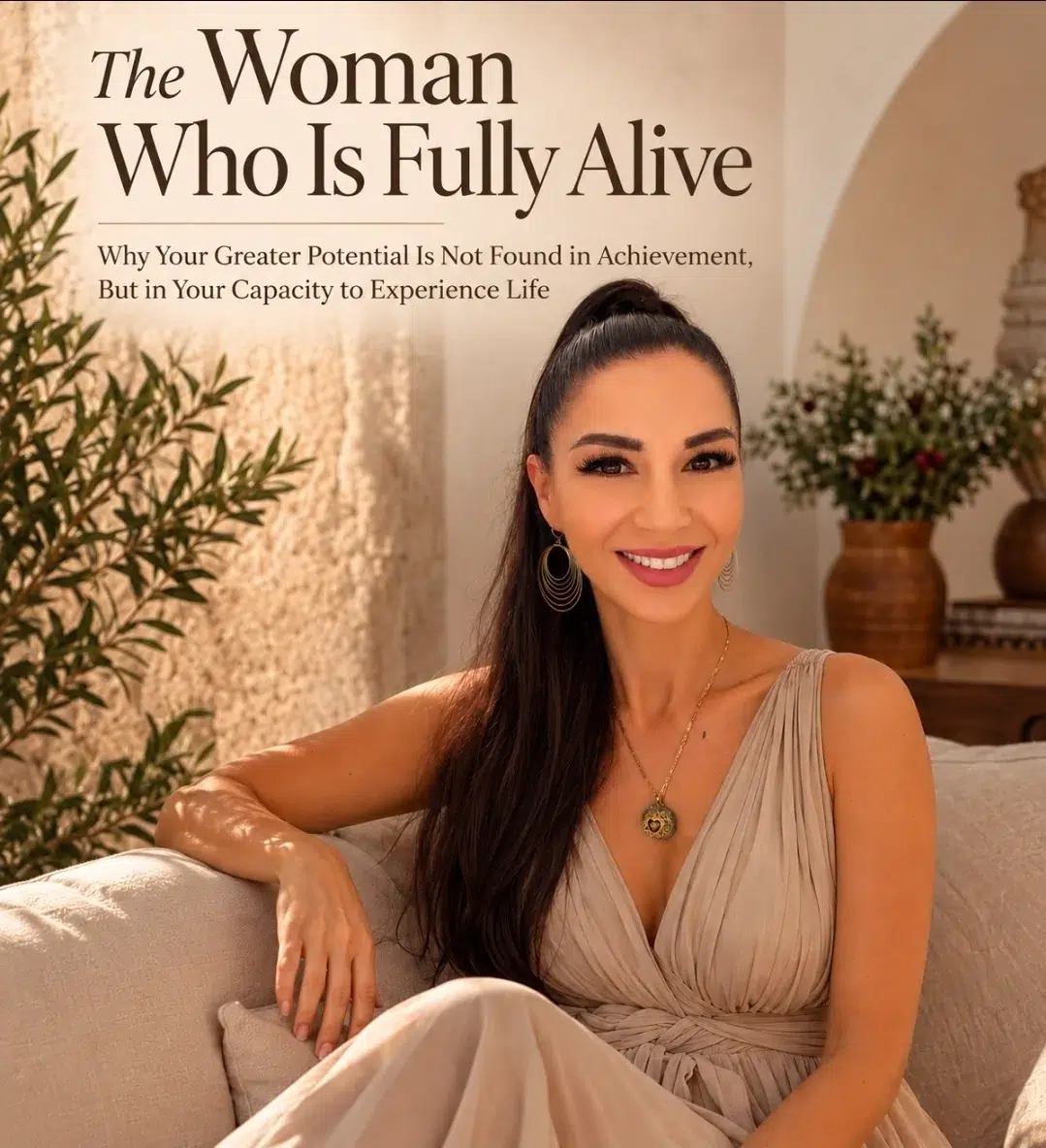
The Woman Who Is Fully Alive
Why Your Greatest Potential Is Not Found in Achievement, but in Your Capacity to Experience Life
Part I • We Were Never Meant Only to Survive
Chapter One
The Hidden Cost of Living in Survival
Chapter Two
When We Stop Feeling Fully Alive
Chapter Three
Why Success Without Aliveness Never Feels Like Enough
Part II • Expanding Human Capacity
Chapter Four
The Nervous System Was Designed for More Than Protection
Chapter Five
Creating From Joy Instead of Fear
Part III • Becoming the Woman Who Receives Life
Chapter Six
The Capacity to Hold Love, Beauty and Abundance
Chapter Seven
A Final Reflection
Part I • Beyond Survival
Chapter One
The Day We Forget We Are Alive
One of the quietest tragedies of modern life is not that we become exhausted. It is that we slowly forget what it feels like to be fully alive.
This forgetting rarely happens all at once. There is no single moment when we consciously decide to disconnect from ourselves or from the richness of life surrounding us. Instead, it unfolds gradually through thousands of ordinary days. We become increasingly occupied by responsibilities, deadlines, expectations and the invisible pressure to keep everything moving. Our attention narrows towards what must be managed, solved and completed. Without noticing, we begin measuring the quality of our lives by what we produce rather than by how deeply we are able to experience them.
Many women become extraordinarily successful at surviving.
They become dependable, capable and resilient. They learn to carry enormous responsibilities while continuing to care for the people around them. From the outside, their lives often appear full. Yet beneath that competence, many quietly describe a feeling that is surprisingly difficult to explain. They tell me they no longer feel connected to themselves. They struggle to remember the last time they felt genuine wonder. Beauty passes unnoticed. Joy feels fleeting. Rest becomes another task to accomplish. Life continues moving forward, yet something essential seems to have faded.
What fascinates me is that this experience is not simply psychological. It is profoundly biological.
The nervous system is designed with one primary responsibility: to keep us alive. Every second of every day, the brain is predicting, regulating and allocating the body’s precious resources in order to help us adapt to an ever changing world. It continually asks one essential question: What will most increase our chances of navigating what comes next? This remarkable capacity has allowed our species to survive extraordinary challenges throughout history. Yet the same intelligence that protects us can also shape the way we experience life itself.
When the nervous system repeatedly encounters stress, uncertainty or prolonged periods of vigilance, it begins organising more of its resources around protection. Attention naturally becomes narrower. The brain prioritises efficiency over exploration and predictability over novelty. From an evolutionary perspective, this makes perfect sense. A nervous system focused on immediate survival cannot afford to become distracted by every beautiful sunset or birdsong drifting through the trees. Its task is to identify potential threats, conserve energy and prepare the body for whatever may require its attention next.
This adaptive process is one of the greatest triumphs of human evolution.
It is also one of the reasons so many people quietly lose contact with the extraordinary richness of ordinary life.
The more the nervous system becomes organised around protection, the more difficult it becomes to notice the experiences that make life feel deeply meaningful. Curiosity gives way to efficiency. Presence gives way to anticipation. Wonder slowly gives way to routine. We continue existing, yet we stop fully participating in the experience of being alive.
Over the years, I have become increasingly interested in this distinction because I believe it changes the entire purpose of healing.
For a long time, I thought the goal of healing was simply to reduce suffering. To become less anxious. Less overwhelmed. Better rested. More emotionally regulated. Those outcomes remain deeply important, and they profoundly improve the quality of our lives. Yet the more I immersed myself in neuroscience, embodiment and the remarkable intelligence of the nervous system, the more another question began quietly emerging.
What if healing was never meant to be the destination?
What if it was always preparing us for something greater?
Across cultures and throughout history, philosophers, poets, contemplative traditions and spiritual teachers have all returned to remarkably similar questions. What does it mean to flourish? What allows a human being not merely to survive, but to live well? Although these traditions offer different answers, they share one beautiful assumption. Human life reaches its fullest expression not only through safety, but through presence. Not only through protection, but through participation. Not only through existing, but through becoming deeply available to the mystery, beauty and meaning woven into everyday life.
Modern neuroscience is beginning to illuminate parts of this ancient intuition. Research on awe, aesthetic experience and human flourishing suggests that experiences of beauty, nature, music and profound connection can influence our physiology, broaden attention, strengthen social connection and contribute to wellbeing. These experiences appear to shift the nervous system towards states that support openness, meaning and connection, even though science is still uncovering the many pathways through which this occurs.
I find something deeply hopeful in this convergence.
Science helps us understand many of the biological processes that support these experiences. Philosophy invites us to ask why they matter. Spiritual traditions remind us that there are dimensions of human existence that cannot always be reduced to measurement, yet have shaped the human story for thousands of years. Rather than competing with one another, I believe these perspectives enrich one another. Together they invite us to remember that being human is both measurable and mysterious. We are biological beings, but we are also meaning making beings. We long not only for safety, but for belonging. Not only for certainty, but for wonder. Not only for survival, but for a life that feels deeply worth living.
Perhaps this is why I no longer believe the highest expression of a healthy nervous system is simply the absence of stress.
I believe its highest expression is availability.
Availability to love without constantly anticipating loss.Availability to receive beauty without rushing past it.Availability to create without being consumed by perfection.Availability to stand beneath a night sky, beside the ocean or in the presence of another human being and allow ourselves to be moved.
Perhaps becoming fully alive has never required us to become someone else.
Perhaps it has always required us to remember what the nervous system has been protecting all along.
Not merely our survival.
But our capacity to experience the extraordinary gift of being alive.
Chapter Two
The Nervous System Was Never Designed Only for Protection
One of the most remarkable qualities of the human nervous system is its extraordinary ability to adapt. Every moment of every day, it gathers information from within the body and from the world around us, continually asking what is required to help us navigate the present while preparing for what may come next. It is a system shaped by millions of years of evolution, refined through countless generations whose survival depended upon their ability to recognise danger, respond quickly and preserve the precious resources required to stay alive.
It is impossible not to feel a sense of awe when we begin understanding the sophistication of this process. Long before we consciously become aware of a situation, the brain has already begun predicting its significance. It compares present experience with memories of the past, evaluates subtle changes within the environment and organises the body’s physiology accordingly. Heart rate adjusts, hormones shift, attention narrows or expands and energy is distributed throughout the body in preparation for what the brain believes is about to happen. Much of this unfolds outside conscious awareness. We simply experience the result.
This predictive intelligence is one of the greatest reasons our species has survived.
Yet there is an important distinction that often goes unnoticed.
The nervous system evolved to help us survive difficult moments.
It was never intended to organise an entire lifetime around them.
When periods of stress are temporary, the nervous system demonstrates extraordinary flexibility. It mobilises resources when challenge arises and gradually returns to greater openness once the challenge has passed. This capacity to move fluidly between protection and restoration reflects the remarkable adaptability of a healthy biological system. Life naturally contains seasons of effort and seasons of recovery. Expansion and contraction. Activity and rest. These rhythms are not signs of imbalance. They are part of the intelligence of living systems themselves.
The difficulty arises when protection quietly becomes our default state rather than our temporary response.
Modern life presents the nervous system with a very different landscape from the one in which it evolved. Many of the challenges we encounter today are not immediate physical dangers but ongoing psychological demands. Constant information, financial uncertainty, social comparison, emotional labour, digital overstimulation and the persistent pressure to perform ask the brain to remain alert for prolonged periods. Although these experiences differ from the threats faced by our ancestors, the nervous system still responds by allocating resources towards protection whenever it predicts that stability may be compromised.
Over time, this continuous state of readiness begins influencing much more than our experience of stress.
It gradually shapes our perception of reality.
One of the most fascinating discoveries in contemporary neuroscience is that the brain does not simply record the world as it is. It actively constructs our experience by combining incoming sensory information with predictions based upon previous experience. We do not passively observe reality. We participate in creating our perception of it. This process allows the brain to operate with extraordinary efficiency, yet it also means that a nervous system organised around protection will naturally notice different aspects of the world than one organised around openness.
A person whose nervous system consistently expects danger may become exceptionally skilled at recognising problems before they fully emerge. Another whose nervous system has experienced greater stability may more easily notice opportunities, beauty and connection. Neither person is consciously choosing what to perceive. Their brain is directing attention towards what it predicts will matter most for survival.
This understanding invites enormous compassion.
Perhaps the woman who struggles to experience joy is not incapable of happiness.
Perhaps her nervous system has simply become exceptionally practised at noticing what requires protection.
Perhaps the woman who finds it difficult to rest is not addicted to productivity.
Perhaps her brain has learned that remaining prepared once increased her chances of navigating life successfully.
Perhaps the woman who rarely experiences wonder has not lost her capacity for awe.
Perhaps her attention has been faithfully organised around vigilance for so long that beauty has simply become more difficult to notice.
When I began understanding this, it changed the way I looked at nearly every aspect of human behaviour.
I stopped asking why people struggled to relax, receive or trust.
I became far more interested in asking what their nervous system had learned to prioritise.
That single shift transformed my understanding of healing.
Healing was no longer about forcing ourselves to become calmer, more positive or more grateful.
Healing became the gradual process of creating enough experiences of safety that the nervous system could begin investing less of its energy in protection and more of its energy in participation.
I believe this distinction is profound.
Because participation is where life actually happens.
We do not fall in love through vigilance.
We do not create our greatest work through chronic self protection.
We do not experience awe while constantly scanning for what could go wrong.
We do not feel deeply connected while our attention is consumed by preparing for the next problem.
The experiences that make life meaningful ask something very different of us.
They ask for presence.
They ask for openness.
They ask for enough internal safety that we can allow ourselves to be touched by beauty, moved by love, inspired by purpose and transformed by wonder.
This is where I believe the conversation about the nervous system must become larger.
For too long, we have spoken about regulation as though calmness were the final destination.
Yet perhaps regulation is simply the foundation.
Perhaps the deeper purpose of a healthy nervous system is not merely to protect us from life.
Perhaps it is to make us available for it.
That possibility changes everything.
Because once the nervous system no longer needs to spend the majority of its resources preparing for survival, an extraordinary amount of energy becomes available.
Energy for imagination.
For creativity.For compassion.For intimacy.For beauty.For service.For prayer.For joy.
For the quiet moments that remind us why being alive is such an extraordinary privilege.
Perhaps that has been the invitation all along.
Not simply to survive this life.
But to participate in it so fully that we become changed by its beauty.
Chapter Three
Why So Many Women Stop Feeling Wonder
One of the quietest losses that accompanies a life organised around survival is not simply the loss of energy. It is the gradual narrowing of perception. Without realising it, many of us stop noticing the very experiences that once made us feel most deeply alive. We continue moving through familiar streets without seeing the changing colours of the trees. We finish conversations without fully remembering the expression on the other person’s face. We watch the sunrise while already thinking about the first meeting of the day. Life continues offering moments of astonishing beauty, yet our attention has become so occupied by anticipation that we struggle to receive them.
This narrowing of awareness is not a personal failure, nor is it evidence that we have become less appreciative of life. It reflects one of the nervous system’s most intelligent adaptations. Attention is one of our most precious biological resources, and the brain allocates it according to what it predicts will be most important for our survival. When our internal model of the world suggests that uncertainty, pressure or potential threat require constant monitoring, attention naturally becomes focused on identifying what needs to be solved, managed or prevented. This process allows us to respond efficiently to challenge, but it also means that much of life’s subtle richness quietly fades into the background of our awareness.
From an evolutionary perspective, this makes perfect sense. An early human who became completely absorbed by the beauty of a landscape while failing to notice signs of danger would have been at a significant disadvantage. Evolution therefore favoured nervous systems capable of prioritising information that increased the likelihood of survival. Yet the modern world presents us with a very different reality. For many people, the greatest demands are no longer immediate physical threats but ongoing psychological and emotional pressures. The nervous system often continues responding as though constant vigilance remains necessary, even when genuine danger is absent. Over time, the habit of scanning for problems becomes so familiar that it begins shaping not only what we notice, but also what we no longer notice.
What fascinates me is that this process affects far more than our experience of stress. It influences our capacity for wonder. Wonder is often misunderstood as a rare emotional experience reserved for extraordinary moments, yet I have gradually come to see it differently. I believe wonder is a way of perceiving. It is the willingness to allow ourselves to be surprised by life, to encounter the ordinary with fresh attention and to recognise that existence itself contains far more mystery than our daily routines often allow us to remember. Children move through the world with this quality almost effortlessly. A puddle becomes an adventure. A butterfly can hold their attention for several minutes. They ask questions not because they need immediate answers but because curiosity itself is deeply satisfying. Their nervous systems are naturally organised towards exploration, learning and discovery.
As we grow older, however, many of us begin replacing curiosity with efficiency. We become rewarded for solving problems quickly, making decisions rapidly and moving from one task to the next with increasing productivity. These capacities are valuable, yet they also carry a subtle cost when they become the dominant way we engage with the world. Efficiency is concerned with arriving. Wonder is interested in experiencing. One measures progress by completion, while the other discovers meaning through attention. Neither is inherently better than the other, but when efficiency becomes our only way of living, we gradually lose contact with one of the deepest sources of human vitality.
Over the past decade, researchers have become increasingly interested in experiences of awe and wonder, not simply because they are emotionally moving, but because they appear to influence the way we think, feel and relate to others. Studies suggest that experiences of awe can temporarily reduce self-focused thinking, increase feelings of connection and encourage greater openness to new perspectives. People often describe these moments as expanding their sense of time, increasing gratitude and creating a deeper feeling of belonging within the larger fabric of life. Science is still exploring the mechanisms involved, yet these findings resonate remarkably well with what philosophers and contemplative traditions have suggested for centuries. Human beings do not flourish only through achievement. We flourish through experiences that remind us we are part of something infinitely larger than ourselves.
I often wonder whether this is why beauty has always played such an important role in every civilisation. Across cultures, people have created music, poetry, art, architecture and sacred spaces that invite the human mind beyond immediate survival. These creations were rarely designed merely to entertain. They invited reflection. They awakened reverence. They reminded people that life possesses dimensions which cannot always be measured yet profoundly shape the way we experience being alive. Whether standing beneath the ceiling of an ancient cathedral, listening to a symphony or walking through an untouched forest, human beings have consistently reported remarkably similar experiences. Something within them becomes quieter while something else becomes infinitely more awake.
Perhaps this is because wonder gently interrupts the nervous system’s habit of prediction. For a brief moment, we stop organising our attention around what comes next and become fully available to what is here. We are no longer living almost entirely inside our internal models of the future. We are meeting reality directly. I believe this shift is one of the most precious experiences available to us because it reminds us that life is not merely a sequence of problems waiting to be solved. It is also an invitation to participate in beauty, relationship, creativity and meaning.
This has gradually transformed the way I understand healing. I no longer believe the goal is simply to reduce anxiety or become more resilient. Those outcomes matter deeply, but they are not the whole story. The deeper invitation is to expand our capacity to notice what survival has often caused us to overlook. Healing creates the conditions in which wonder becomes available again. It widens our perception so that we can once again be moved by birdsong, touched by kindness, inspired by beauty and surprised by the extraordinary richness hidden within ordinary moments.
Perhaps becoming fully alive is not about adding something new to our lives.
Perhaps it is about recovering our capacity to notice what has been quietly present all along.
Part II • Human Expansion
Chapter Four
Joy Is Creative Intelligence
There is a tendency within modern culture to speak about joy as though it were an emotional luxury. We imagine it arriving after everything else has been accomplished, once our responsibilities have been fulfilled, our problems have been solved and the conditions of our lives have finally become favourable enough to allow us to relax. Joy becomes something postponed until later, quietly waiting on the other side of success, certainty or achievement.
Yet the longer I have explored both neuroscience and the lived experience of human flourishing, the more convinced I have become that this understanding is incomplete. Joy is not simply the reward we receive after life becomes easier. It is one of the conditions that allows us to participate in life more fully. It changes the way we perceive, the way we relate, the way we create and even the way we imagine what is possible.
One of the most fascinating aspects of the nervous system is that our emotional states do not simply reflect the world around us. They actively influence the range of possibilities our brain is able to perceive. Researchers in positive psychology, particularly the work of Barbara Fredrickson, have suggested that emotions such as joy, love, curiosity and gratitude broaden attention and increase cognitive flexibility. Rather than becoming narrowly focused on immediate survival, the mind becomes more capable of exploring, learning, creating and forming meaningful relationships. These emotional states do not simply feel pleasant. They appear to expand the range of options the brain is able to consider.
From an evolutionary perspective, this is remarkably intelligent.
When survival is uncertain, narrowing attention increases efficiency. The nervous system allocates resources towards immediate protection because responding quickly may be essential. However, when sufficient safety is present, an entirely different mode of functioning becomes possible. Exploration becomes valuable. Creativity becomes adaptive. Play strengthens learning. Curiosity encourages discovery. Connection deepens cooperation. In other words, the nervous system begins investing its resources not only in preserving life, but also in enriching it.
This distinction has transformed the way I understand joy.
I no longer see it merely as a pleasant emotional experience.
I see it as evidence that the nervous system possesses enough available capacity to engage with life beyond immediate survival.
That does not mean a joyful person never experiences grief, uncertainty or pain. Human life will always contain moments of profound challenge. Rather, joy reflects the remarkable ability to remain available to beauty, connection and meaning even while acknowledging the complexity of life itself. It is not the denial of suffering. It is the refusal to allow suffering to become the only lens through which life is experienced.
Across history, philosophers and contemplative traditions have often described joy in similarly expansive ways. Joy was rarely understood as constant happiness or emotional excitement. Instead, it was seen as a natural expression of living in harmony with one’s deepest nature, of participating fully in existence and of recognising the intrinsic value of life itself. Although these traditions emerged from different cultures and languages, many shared the intuition that joy was not something to pursue directly. It emerged as a consequence of living in alignment with what is true, meaningful and deeply life giving.
I find it remarkable that modern neuroscience and ancient wisdom, while approaching the question from different directions, both point towards a similar understanding. Science helps explain some of the biological conditions that support openness, connection and creativity. Philosophy and contemplative traditions invite us to reflect on what we choose to do with that openness once it becomes available. Together they remind us that human flourishing involves far more than the absence of illness. It involves the presence of vitality.
Perhaps this is why I have become increasingly interested in the relationship between joy and creativity.
When I speak about creativity, I am not referring only to painting, writing or music. Creativity is the capacity to bring something new into the world. It is expressed every time we imagine a different future, nurture a relationship, solve a complex problem, build a business, prepare a nourishing meal or respond to life with fresh awareness instead of automatic habit. Creativity is one of the most profound expressions of participation. It reflects a nervous system that is no longer consumed solely by protecting what already exists, but is beginning to contribute something new.
This is particularly meaningful because many women tell me they feel as though they have lost their creativity. They often assume they have become less imaginative or less inspired. Yet I have rarely found this to be true. More often, I meet women whose nervous systems have been carrying such a significant protective load that very little energy remains available for exploration. Their creativity has not disappeared. It has been patiently waiting for enough capacity to emerge again.
Over the years, I have witnessed something extraordinary happen when women begin rebuilding that capacity. As their relationship with their nervous system changes, they often discover that creativity returns naturally. New ideas begin arriving during quiet walks. Long forgotten dreams gently resurface. They become curious again. They laugh more easily. They begin noticing beauty where previously they noticed only responsibility. From the outside, it may appear that they have become more creative. From the inside, I believe something even more profound has occurred. They have become more available to life.
Perhaps this is why I no longer believe joy is the destination we reach after creating a meaningful life.
I believe joy is one of the conditions that allows meaningful creation to happen in the first place.
When our nervous system no longer spends all of its precious resources preparing for survival, it begins doing what living systems have always been designed to do.
It begins exploring.It begins connecting.It begins imagining.It begins creating.
And perhaps that is one of the clearest expressions of a woman who is becoming fully alive.
Chapter Five
Beauty Is Not a Luxury. It Is Nourishment for the Human Spirit
If I were asked what has transformed my own nervous system most profoundly over the years, my answer would not begin with a technique.
It would begin with beauty.
Not because beauty solved every challenge I have ever faced, but because it continually reminded me that life was infinitely larger than the problems my mind was trying to solve.
There have been mornings when watching the first light touch the horizon brought me into a deeper state of presence than hours spent analysing my thoughts. There have been moments when standing beside the sea, listening to birds before sunrise or simply watching the quiet intelligence of an animal completely changed the way my body experienced the world. Nothing external had fundamentally changed. My responsibilities were still waiting. My unanswered questions remained unanswered. Yet something within me had become different. My nervous system no longer experienced life through the narrow lens of protection. It had remembered something larger.
For many years I believed these moments were simply pleasant experiences. Today I understand them differently. I believe beauty is one of the most profound forms of nourishment available to the human nervous system.
This understanding is slowly finding support within contemporary neuroscience. Researchers studying experiences of awe have discovered that encounters with extraordinary beauty, whether through nature, music, art or vast landscapes, can influence the way the brain processes both ourselves and the world around us. These experiences often reduce excessive self focused thinking, increase feelings of connection and encourage a broader perspective from which everyday problems no longer appear quite so overwhelming. The nervous system momentarily loosens its habitual focus on protection and becomes more available for openness, curiosity and relationship.
Yet I believe beauty offers us something that reaches beyond what science alone can currently explain.
Across thousands of years of human history, beauty has occupied a sacred place in nearly every civilisation. The ancient Greeks associated beauty with harmony and the cultivation of a flourishing life. Many contemplative traditions have regarded beauty as one of the ways human beings encounter transcendence, inviting us beyond the limitations of ordinary perception into a deeper awareness of existence itself. Artists, poets and mystics have consistently described beauty not simply as something pleasing to the eye, but as an experience that awakens the whole person. Although each tradition uses different language, they point towards a remarkably similar insight. Beauty has the capacity to change us because it changes the quality of our attention.
Perhaps this is why beauty cannot be reduced to decoration or luxury. It is not something reserved for museums, holidays or extraordinary occasions. Beauty is woven into the ordinary fabric of life, quietly waiting for our attention. It exists in the intricate geometry of a leaf, in the rhythm of waves returning endlessly to the shore, in the warmth of sunlight falling across a wooden table, in the laughter of a child, in the eyes of an ageing parent and in the faithful companionship of an animal who asks nothing from us except our presence. These moments often appear insignificant because they are so familiar. Yet familiarity has a curious way of making us overlook the very things capable of nourishing us most deeply.
One of the greatest consequences of living in prolonged survival is not simply that we become tired. It is that we gradually stop perceiving beauty with the same openness we once possessed. The nervous system becomes exceptionally skilled at identifying what is missing, what remains unfinished and what still requires our attention. This ability serves us well when genuine problems need solving, but it quietly narrows our experience of life. We begin seeing the world primarily through the lens of utility. We ask what something can do, what it costs, how quickly it can be completed or whether it helps us move towards the next objective. In doing so, we slowly lose our capacity to encounter life simply for the sake of experiencing it.
Children rarely relate to the world this way. Watch a young child walking through a forest and you will notice that almost everything becomes worthy of attention. Stones are examined with fascination. Insects become endless sources of curiosity. The changing colours of the sky inspire questions rather than indifference. This openness is not accidental. It reflects a nervous system naturally organised towards exploration and learning. Children are not simply gathering information about the world. They are participating in it with their whole being.
As adults, we often mistake this quality for innocence when perhaps it is actually one of the highest expressions of human consciousness. To experience wonder requires far more than seeing with our eyes. It requires enough internal spaciousness that we are no longer consumed by the constant anticipation of what comes next. Beauty cannot be hurried. It asks for attention. It asks for presence. It asks us to pause long enough for the nervous system to remember that life is not merely a sequence of problems to solve but a reality to experience.
This understanding has profoundly influenced the way I live. I no longer think of beauty as something I appreciate only when life becomes easier. I intentionally seek it because I recognise the way it shapes my relationship with the world. Spending time in nature, listening deeply to music, surrounding myself with fresh flowers, caring for animals, praying in stillness or watching the changing seasons are no longer pleasant additions to my life. They have become essential conversations with my nervous system. They remind my body that the world contains far more than urgency. They remind me that life is continually offering evidence of harmony, creativity and quiet intelligence if I am willing to notice it.
Perhaps this is one of the reasons beauty has always inspired both artists and scientists alike. Science reveals extraordinary complexity. Beauty allows us to experience it. One explains the mechanisms through which life unfolds. The other invites us into a relationship with the mystery that remains. Together they remind us that understanding life and experiencing life are not the same thing. One enriches the other.
I often wonder whether one of the deepest forms of healing is not simply recovering from what has hurt us, but recovering our ability to be moved by what is beautiful. Because when beauty touches us, even briefly, something remarkable happens. The nervous system remembers that it was never created solely to defend life.
It was also created to recognise its extraordinary richness.
And perhaps a woman who has learned to truly receive beauty has already begun remembering what it means to be fully alive.
Part III • Living Fully Awake
Chapter Six
The Capacity to Receive Life
One of the questions that has accompanied me for many years is this:
Why do two people experience the very same moment so differently?
One person stands beside the ocean and feels profoundly moved by its beauty, while another immediately reaches for their phone. One receives a sincere compliment with quiet gratitude, while another instinctively dismisses it. One allows love to soften them, while another becomes anxious the very moment intimacy begins to deepen. Outwardly, the circumstances appear almost identical, yet inwardly they become entirely different experiences.
For a long time, I believed these differences reflected personality. I assumed some people were naturally optimistic, emotionally open or simply better at appreciating life. The more deeply I immersed myself in neuroscience, embodiment and the extraordinary adaptability of the nervous system, however, the more I realised that another explanation deserved our attention.
Perhaps our experience of life is shaped not only by what life offers us, but by what our nervous system has developed the capacity to receive.
This distinction has quietly transformed almost everything I teach.
We often speak about receiving as though it were simply a decision. We encourage people to receive more love, more support, more abundance or more joy, assuming that if they genuinely desired these experiences, they would naturally welcome them into their lives. Yet lived experience suggests something more complex. Desire alone does not determine what we can comfortably receive. The nervous system also participates in that conversation.
Every meaningful experience enters the body before it becomes a story in the mind. A kind word, a moment of affection, the beauty of a landscape, the success of a long-awaited project or the stillness that arrives during prayer are all first experienced physiologically. The brain interprets these experiences in light of everything it has previously learned about safety, belonging and survival. When openness has repeatedly been associated with disappointment, receiving may feel unexpectedly vulnerable. When self-worth has depended upon constant effort, rest may feel uncomfortable rather than nourishing. When love has been unpredictable, genuine care may initially awaken vigilance instead of ease.
None of these responses indicate that something is broken within us.
They reveal how faithfully the nervous system continues organising itself around the experiences that once helped us navigate the world.
This understanding invites enormous compassion because it shifts the conversation away from self criticism and towards curiosity. Instead of asking why we struggle to receive what we long for, we begin asking what our nervous system has learned about receiving itself. What evidence has it collected over the years? What expectations quietly shape its predictions? Which experiences taught it that remaining guarded was wiser than remaining open?
These questions matter because the nervous system is never responding only to the present moment. It is responding to the present through the lens of accumulated experience. Every relationship, every environment, every season of life contributes to the internal models through which new experiences are interpreted. This is why two women can encounter the same opportunity while responding in profoundly different ways. One experiences possibility. Another experiences pressure. One feels expansion. Another feels uncertainty. The external event remains the same. The internal landscape through which it is received differs entirely.
Yet one of the most hopeful discoveries within neuroscience is that these internal landscapes are not fixed. The brain remains remarkably capable of adaptation throughout life. Every experience of genuine safety, authentic connection, meaningful creativity or quiet presence becomes another opportunity for prediction to evolve. Little by little, the nervous system begins gathering new evidence. It discovers that support does not always require repayment. That love does not inevitably end in abandonment. That stillness is not synonymous with danger. That joy does not have to be followed immediately by loss.
This gradual expansion of capacity may be one of the most beautiful expressions of human development.
For centuries, philosophers have suggested that the quality of our lives depends less upon what we possess and more upon the way we encounter existence itself. Many contemplative traditions have spoken about cultivating an inner spaciousness through which gratitude, compassion and presence naturally arise. While neuroscience approaches these questions through a different language, I find the conversation remarkably complementary. The nervous system helps us understand how that spaciousness may gradually become embodied. Spiritual wisdom reminds us why it matters.
I have come to believe that perhaps the deepest form of abundance is not measured by what enters our lives but by what we are able to fully receive once it arrives.
There are people surrounded by extraordinary success who remain unable to experience satisfaction because the nervous system continues anticipating what might disappear next. Others possess relatively little by conventional standards, yet move through life with a profound sense of gratitude because they have developed the capacity to remain present with what already exists. This is not an argument against ambition or achievement. Rather, it reminds us that no external circumstance can replace the internal capacity to experience it.
This understanding has quietly reshaped my own life.
Today, I pay far more attention to the quality of my presence than to the quantity of my accomplishments. I intentionally create moments in which my nervous system can receive rather than simply produce. Sometimes that means sitting quietly with my morning tea before the day begins. Sometimes it means allowing myself to be completely absorbed by the colours of a sunset, the intelligence in an animal’s eyes or the silence that follows prayer. Sometimes it means receiving another person’s kindness without immediately searching for a way to reciprocate. These moments may appear small, yet they are continually teaching my nervous system that life is not only something to manage.
It is something to receive.
Perhaps this is where the journey beyond survival truly begins.
Not when life becomes perfect.
Not when uncertainty finally disappears.
But when the nervous system gradually develops enough trust to remain open in the presence of beauty, love, purpose and joy without immediately retreating into protection.
Because perhaps the greatest wealth available to any human being is not measured by what we accumulate.
Perhaps it is measured by the depth with which we are able to receive the extraordinary experience of being alive.
Chapter Seven
Living as a Woman Who Is Fully Alive
There comes a point in every meaningful journey when understanding is no longer enough.
A woman may understand how her nervous system works. She may recognise the patterns that once organised her life around protection. She may appreciate the importance of joy, beauty, wonder and self trust. She may even notice profound changes taking place within herself. Yet sooner or later another question naturally emerges.
How do I live this?
Not occasionally.
Not during meditation.
Not only on holiday or after a retreat.
But within the ordinary rhythm of everyday life.
I believe this question marks the beginning of true embodiment.
Embodiment is often misunderstood as a collection of practices designed to help us feel calmer or more connected to our bodies. While these practices can certainly support us, embodiment itself is something far more comprehensive. It is the gradual alignment between what we understand intellectually, what we experience physiologically and the way we choose to meet life each day. It is the point at which knowledge is no longer something we possess but something we live.
Over the years, I have realised that becoming fully alive rarely requires dramatic external change. More often, it asks for a profound transformation in the quality of our attention. Two women may live lives that appear remarkably similar from the outside. They may wake at the same hour, care for their families, build meaningful work and navigate similar responsibilities. Yet one moves through her day almost entirely organised around urgency, while the other remains deeply connected to the experience of living. The difference is not necessarily found in what they do. It is found in the way their nervous systems participate in each moment.
A woman whose life is organised around survival often experiences every day as something to complete. Her attention naturally moves towards what remains unfinished, what still requires effort and what must be controlled in order to create safety. Even moments of rest can quietly become opportunities to prepare for what comes next. Although she may accomplish extraordinary things, much of her energy remains invested in managing life rather than experiencing it.
As the nervous system gradually develops greater capacity, however, another way of living begins to emerge. Responsibilities do not disappear. Challenges continue arising, and uncertainty remains part of every human life. Yet the relationship with those experiences changes. They no longer define the entire landscape of attention. Space gradually becomes available for noticing beauty while walking to work, for listening deeply during conversation without mentally rehearsing the next response, for feeling gratitude while preparing an ordinary meal or for pausing long enough to watch sunlight moving across the floor. These moments may appear insignificant, yet together they create an entirely different experience of being alive.
This is one of the reasons I no longer separate wellbeing from the way we inhabit ordinary moments. Human life is not experienced only through extraordinary achievements or defining milestones. It is built through thousands of seemingly ordinary experiences that quietly shape the relationship we have with ourselves and with the world around us. The quality of those moments gradually becomes the quality of our lives.
Many philosophical traditions have suggested that the deepest wisdom is not found by escaping ordinary life but by becoming fully present within it. The sacred is discovered not only in exceptional experiences but also in everyday acts of attention, gratitude and presence. I find this deeply meaningful because it mirrors what I have witnessed in my own life. The moments that have transformed me most profoundly were rarely dramatic. They often arrived quietly, asking nothing more than my willingness to be completely present.
I have also come to believe that living fully awake naturally changes the way we relate to others. As our nervous system becomes less consumed by constant protection, we become more emotionally available. We listen more generously. We lead with greater clarity because fear no longer dominates every decision. We become less interested in proving our worth and more interested in contributing something meaningful. Relationships become places of genuine meeting rather than unconscious negotiation. Compassion becomes easier because our internal resources are no longer entirely devoted to self protection.
Perhaps this is one of the greatest gifts of expanding our capacity. We discover that healing was never only about ourselves. Every nervous system influences the people around it. A regulated, open and present human being becomes part of the environment through which others experience safety. The way we speak, listen, lead and love quietly shapes the nervous systems of our children, our partners, our communities and everyone whose lives touch our own. In this sense, becoming fully alive is not an individual achievement. It is an act of contribution. As we become more available to life, we naturally create conditions in which others can begin experiencing more of their own aliveness as well.
For me, this is where science, embodiment, and what I can only describe as the deeper mystery of life begin to meet. Science helps us understand the extraordinary intelligence through which the nervous system adapts and learns. Embodiment teaches us how to live that understanding through our own experience. Beyond both lies a quiet invitation that humanity has explored for centuries: the invitation to participate consciously in life itself. Whether we describe that participation through the language of purpose, consciousness, faith or simply profound presence, it reminds us that being alive is about far more than avoiding suffering. It is about becoming increasingly available to love, beauty, truth and the countless moments through which life continually reveals its richness.
Perhaps this is what a fully alive woman ultimately embodies.
She does not live without difficulty.
She does not become fearless.
She does not seek perfection.
She simply stops organising her entire existence around protection.
Instead, she begins organising it around participation.
She chooses to meet each day with curiosity rather than habitual anticipation. She allows beauty to interrupt her schedule, love to soften her heart and wonder to expand her perception. She continues growing, creating and serving, not because she is trying to earn her worth, but because life itself has become something she is deeply grateful to participate in.
When I imagine the woman this essay has been written for, I do not imagine someone who has finally mastered life.
I imagine a woman who has remembered something she always carried within her.
That beneath every layer of protection, every season of healing and every chapter of becoming, there has always existed a quiet capacity waiting to awaken.
The capacity not merely to survive this extraordinary life…
but to receive it.
A Final Reflection
Perhaps the greatest misunderstanding about healing is that we imagine its purpose is simply to help us suffer less.
We long to become less anxious, less overwhelmed, less exhausted and less burdened by the weight we have carried for so long. These are deeply meaningful aspirations, and when the nervous system begins finding greater stability, life changes in profound ways. We think more clearly, relate more openly and experience a greater sense of internal steadiness. Yet the longer I have walked this path myself and the more women I have had the privilege of walking beside, the more I have found myself returning to a different question.
What if healing was never the destination?
What if it was always the beginning?
Throughout this Journal, we have explored the remarkable intelligence of the nervous system and the countless ways it quietly shapes our experience of being human. We have seen how the brain manages the body’s precious resources, how it predicts the future based upon the past and how it continually adapts in order to protect the life entrusted to it. We have also discovered that the same nervous system capable of organising itself around survival possesses an equally extraordinary capacity for change. It can learn. It can adapt. It can become increasingly available to experiences that once felt unfamiliar or even unsafe.
This understanding changes the way I see human potential.
For many years, I thought our greatest achievement was resilience. I admired the ability to endure, to persevere and to continue moving forward despite difficulty. While resilience remains a beautiful human quality, I no longer believe it represents our highest possibility. A person can become remarkably resilient while still remaining emotionally disconnected from life. They can endure almost anything while quietly forgetting how to experience joy, wonder or deep presence.
Perhaps our greatest potential lies somewhere beyond resilience.
Perhaps it lies in aliveness.
Aliveness cannot be measured by productivity, success or even emotional comfort. It reveals itself in subtler ways. It appears in our ability to remain present during an ordinary conversation. In the gratitude we feel while watching the morning light enter a room. In the courage to love despite life’s uncertainties. In the willingness to create without knowing exactly how our work will be received. In the capacity to stand beneath a night sky, beside the ocean or among ancient trees and allow ourselves to feel part of something infinitely greater than our individual concerns.
These moments are easy to overlook because they rarely announce themselves as extraordinary. Yet I have gradually come to believe they are among the most important experiences a human being can have. They remind us that life is not asking only for our efficiency. It is inviting our participation.
Science continues revealing astonishing insights into the way the nervous system supports human flourishing, and I find myself continually inspired by these discoveries. At the same time, I remain deeply humbled by the mystery that still surrounds consciousness, love, beauty and meaning. There are dimensions of being human that no laboratory can fully measure and no theory can completely explain. For thousands of years, philosophers, contemplative traditions and spiritual teachers have explored these questions, each offering language for experiences that continue touching something universal within us. I do not see these perspectives as competing with science. I see them as expanding the conversation. Together they remind us that understanding life and experiencing life are not the same thing.
Perhaps this is why I have become less interested in asking whether we are healing and more interested in asking what our healing is making possible.
Is it allowing us to love more deeply?
To listen more generously?
To receive beauty more fully?
To create with greater freedom?
To become more present with the people who matter most?
To live in a way that leaves the world a little kinder than we found it?
These questions feel far more important to me than the pursuit of perfection because they invite us to measure our lives not only by what we accomplish but by how deeply we participate in the extraordinary privilege of being here.
When I imagine the woman reading these words, I do not imagine someone who has finally figured everything out. I imagine a woman who is becoming increasingly willing to trust her body, honour her humanity and remain open to the mystery of life itself. She understands that healing is not about removing every challenge. It is about developing the capacity to meet life without continually abandoning herself. She knows that the nervous system is not simply something to regulate but a remarkable living system through which she experiences every conversation, every sunrise, every relationship and every dream she will ever hold.
Perhaps this is the deepest invitation I hope these pages leave with you.
May you become less concerned with simply getting through life and more devoted to truly experiencing it.
May your nervous system gradually discover that safety and openness can exist together.
May your days become rich with moments that cannot be measured but can be deeply felt.
May you never lose your capacity to be moved by beauty, softened by love, awakened by wonder or inspired by the quiet intelligence woven through the living world.
And above all, may you remember that beneath every layer of protection your nervous system has ever built, there has always been something beautifully intact.
A human being created not merely to survive this life…
but to participate in it with an open heart.