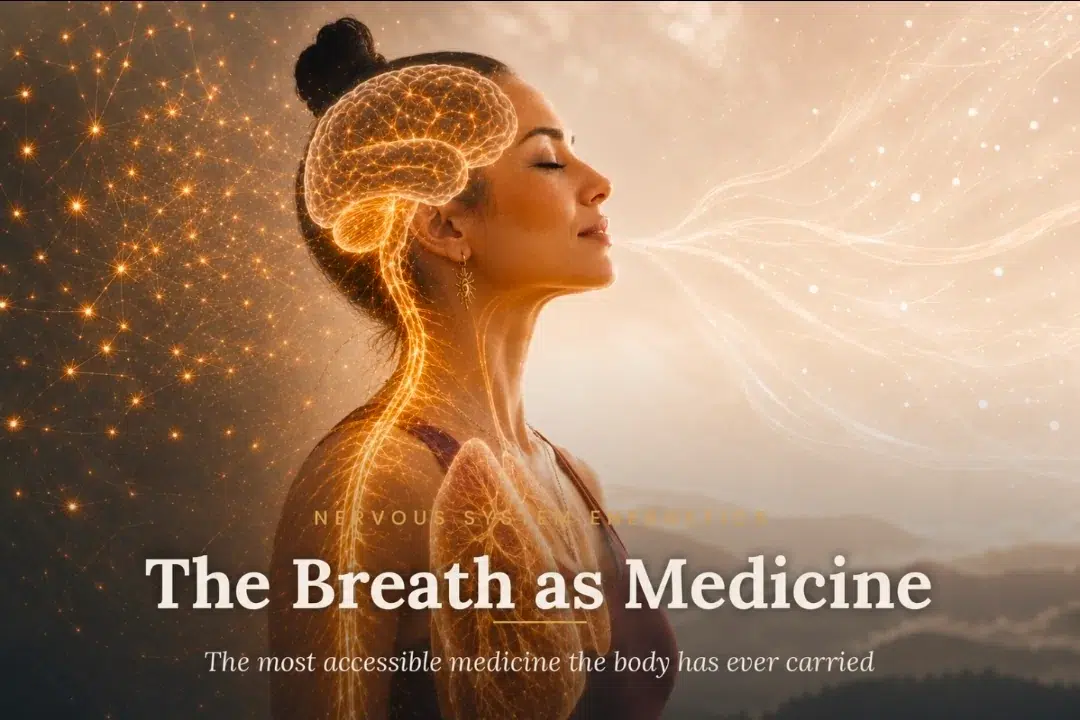
On the most accessible tool the body has ever carried, and what it can quietly do for the brain, the nervous system, and the parts of us words have never reached.
There is a medicine your body has been carrying its whole life, and most of us were never taught how to use it. It is older than language, more direct than thought, and so quiet that we forget it is there. It is the breath. And what the research is now showing about what it can do, gently and consistently, is changing the conversation about how healing actually works.
I have studied many tools in this work, and I keep many of them close. But if I were ever asked to name the one I return to most, the one that has done the deepest work with the most women, it would not be the most impressive or the most exotic. It would be the one that has been with us since the moment we were born. The breath is the only autonomic function in the body we can consciously change. Which means it is the one door that is always open, in both directions, between the part of us that thinks and the part of us that simply is.
The most direct door in the body
Inside your body, almost every essential function happens without your involvement. Your heart beats, your hormones rise and fall, your digestion unfolds, your immune system fights, your nervous system regulates moment by moment, all without your conscious choosing. Breath is the one exception. You can change its depth, its pace, its rhythm, simply by deciding to. And in that small, quiet act, you are touching the only system in the body that lives in both worlds at once, the voluntary one you think you control, and the involuntary one that has been quietly carrying you.
The reason this matters so much is not philosophical. It is neurological. The diaphragm, the great dome of muscle beneath your lungs, is the only striated muscle in the body that is also part of the autonomic nervous system. It belongs to both. Which means each time you change your breath, you are stepping directly into the body’s autopilot, the part that runs everything else, and offering it a different signal. You are not asking it. You are speaking its language. And the body, when spoken to in this language, listens.
What the body actually needs is not more oxygen
Most of us, when we feel tense or short of breath, take a big breath in. We have been told all our lives to take a deep breath. But the most surprising piece of physiology, and the one that quietly changes everything once you understand it, is this. Your body almost never needs more oxygen. What it needs is more tolerance for carbon dioxide.
In 1904, a Danish physiologist named Christian Bohr discovered something that still shapes everything we know about breath. Carbon dioxide, which we have been taught is only a waste product to exhale, is actually the signal that releases oxygen from your blood into your tissues. Without enough CO2 circulating in your system, the oxygen you breathe in stays bonded to your red blood cells and never reaches the muscles and organs that need it. This means a body that breathes too fast, too shallow, too often, is paradoxically a body starved of oxygen. Not because it is not getting any. Because it cannot deliver what it has.
This is what chronic stress does to the breath. It pushes us into fast, shallow, often mouth breathing, exhaling carbon dioxide faster than the body can use it. The result is a cluster of symptoms that so many women know intimately, the lightheadedness, the tightness in the chest, the strange exhaustion despite enough sleep, the feeling of never quite being able to catch your breath. The answer is not to breathe more. It is to breathe less, more slowly, and through the nose, so that CO2 has time to do its work. Nasal breathing also adds something most of us were never taught. Each pass of air through the nose produces nitric oxide, a molecule that dilates blood vessels and improves oxygen delivery throughout the entire body. The simple act of closing your mouth and breathing through your nose is, quite literally, more medicine than most people realise.
What the Stanford research quietly proved
In 2023, researchers at Stanford published a study in Cell Reports Medicine that the world of meditation and mindfulness has been quietly trying to make sense of ever since. The study, led by Melis Yilmaz Balban with Andrew Huberman and David Spiegel, took 111 healthy adults and asked them to commit to one of four practices for just five minutes a day for 28 days. Three were breathwork techniques, and the fourth was mindfulness meditation. The aim was simple. Would something change in their mood, in their breathing rate, in the calm of their nervous system, and which practice would do the most.
The result was clear. All three breathwork groups improved more than the meditation group. They reported better moods, lower anxiety, and slower resting breathing rates by the end of the month. But the breathwork practice that did the most was the one with the longest exhale, what the researchers called cyclic sighing. A double inhale through the nose followed by a long exhale through the mouth. Five minutes a day. The simplest of all the practices. The most ordinary. And the one that quietly outperformed the rest.
What this tells us is more profound than the practice itself. It is that the body responds to the way we breathe even more directly than it responds to the way we think. And that a longer exhale, more than anything else in that study, is what the nervous system reads as safety.
The conversation between breath and brain
To understand why, we have to look at what happens above the diaphragm. The breath is in constant conversation with the brain through the vagus nerve, the longest cranial nerve in the body and the central pathway of the parasympathetic nervous system. We tend to imagine that the brain commands the body, but the vagus nerve runs mostly the other way. Roughly eighty percent of its fibres are afferent, carrying information from the body upward, reporting to the brain on what is happening below. The brain does not only tell the body what to feel. The body tells the brain.
And the breath is one of the loudest signals it sends. When you slow your breath, especially through a long exhale, you activate stretch receptors in the lungs that send a clear message upward. This system is safe. The brainstem hears it, the limbic system receives it, the prefrontal cortex comes back online. Heart rate variability, the marker researchers now use to measure the body’s flexibility and resilience, can rise dramatically with this kind of slow, even breathing.
Brain imaging studies have also shown that breath patterns directly entrain electrical activity across the amygdala, the hippocampus, the insula and the prefrontal cortex, the very regions involved in fear, memory, emotion and the regulation of self. In other words, when you breathe slowly and consciously, you are not relaxing in some vague way. You are physically rewiring the conversation between the survival parts of your brain and the parts that allow you to feel safe, to think clearly, and to choose your own response.
The hidden circuit between breath and the brain’s alarm
If you have ever wondered why slow breathing calms the mind so completely, the truth is that the actual mechanism remained a mystery for centuries. Yogis observed it, healers used it, every spiritual tradition relied on it, but no one could quite say why it worked. Until 2017, when a team of researchers from Stanford and UCLA published a finding in the journal Science that quietly changed the field.
Deep in your brainstem sits a small cluster of neurons called the preBötzinger complex. It is the breath pacemaker, the part of you that has generated every single breath you have ever taken since birth, without your involvement. What the researchers discovered, and what they had not been looking for, is that a tiny subgroup of around 175 neurons inside this complex sends signals directly upward to the locus coeruleus, the brain’s central alarm and arousal centre. The same centre that fires in panic. The same centre that drives anxiety. The same centre that decides, moment to moment, whether your whole body is on guard or at ease.
This means that breath and arousal are not merely related. They are wired together, directly, on a hidden circuit. When you breathe quickly, those neurons fire more, and the alarm centre is activated through them. When you slow your breath, especially through a long, soft exhale, those neurons quiet, and the alarm centre quiets with them. Slow breathing is not soothing in some soft, vague way. It is literally turning down a dial on the part of your brain that decides whether you are safe. And that dial, until you learn to breathe consciously, is almost entirely out of your reach.
The breath that conducts the heart
There is another conversation breath is constantly having, and this one is with the heart. Each time you breathe in, your heart speeds up just slightly. Each time you breathe out, it slows. This rhythmic interplay between breath and heart is called heart rate variability, and it is one of the most important markers of health that almost no one is taught.
A heart that beats with a healthy, flexible variability is the sign of a nervous system that can move easily between activation and rest, between meeting the world and coming home to itself. A heart that beats too steadily, with too little variation, is the sign of a system locked in survival, no longer flexible enough to respond well to anything. The research is striking. Higher heart rate variability is associated with better immune function, deeper sleep, lower inflammation, lower risk of cardiovascular disease, and in studies followed over many years, even longer life.
And the most remarkable part is this. The breath is the conductor of that rhythm. When you breathe slowly and evenly, at around five to six breaths a minute, your heart and your breath lock into what researchers call resonance, a state in which the entire cardiovascular system enters a kind of coherent harmony. People who reach this state through slow, coherent breathing often describe a feeling they have not had in years, sometimes ever. A settled, expansive aliveness that does not require anything outside themselves to produce it. This is your nervous system meeting its own natural rhythm again. The breath has always been the conductor. We simply forgot how to listen.
Reaching what words cannot reach
Here is the part most people are never told. So much of what shapes our lives never lived in our conscious mind in the first place. The patterns we keep repeating, the reactions that feel automatic, the bodies that brace before we even know we are afraid, the relationships we recreate, the abundance we cannot quite let in, these are not held in the language part of us. They are held in implicit memory, in the body, in the limbic system, in the nervous system itself. This is why insight alone has so rarely been enough to change them. You can understand a pattern completely and still find yourself living it the next morning. The understanding sits in one room. The pattern lives in another.
Breath reaches the room where the pattern lives. Because it bypasses the thinking mind and speaks directly to the autonomic nervous system, breath is one of the only tools in the entire human toolkit that can quietly touch what cannot be put into words. You do not need a story. You do not need to remember anything. You only need to breathe, in a way that signals to your body that it is safe enough to begin releasing what it has been holding. And the body, often for the first time in years, exhales.
How the body learns a new pattern
What is happening underneath all of this is neuroplasticity. The brain and the nervous system are not fixed. They are constantly being shaped by what we repeat. Each time you take a slow, full breath and your body experiences itself as safe, you are not only calming the moment, you are teaching your nervous system a new pattern. A new baseline. A new default.
The science shows this clearly. Breath modulates the calming neurotransmitter GABA, supports the focus chemistry of norepinephrine, increases the brainwave activity associated with learning, memory and creativity, and over time strengthens the connection between the amygdala and the prefrontal cortex, the very connection that decides how reactive or how regulated you are in your daily life. This is why a few weeks of conscious breathing changes more than a few months of trying harder. You are not pushing the system. You are educating it. And the system, given the right inputs, learns.
One of many doors, but often the first
I want to be honest about something. Breath is not the only tool I work with, and I would never want anyone to believe it is the only way home. In my method I weave together many things, somatic and nervous system work, frequency and music, gentle movement, sensory input, deeper inner and unconscious work, the kind of presence that allows the body to feel met. There are days a client needs movement before breath. There are days she needs silence. There are days she needs to feel heard by another human being before any technique becomes useful at all.
But the breath is almost always somewhere in the centre of it. Because it is the most accessible, the most natural, the most universally available tool we have. It costs nothing. It travels with us. It is the one practice no one can ever take away from us. And for most women, it is the first door I open, because it is the door her body trusts the fastest.
A place to begin
If something in you wants to feel what this can do, you do not need a long practice or a teacher in the room to begin. The cyclic sigh from the Stanford study takes less than a minute, and you can do it sitting where you already are. Two short inhales through the nose, the second one gently filling whatever space remains, followed by a long, slow exhale out through the mouth. Repeat that for five gentle minutes. Do not force any of it. Just let the exhale be a little longer than the inhale, again and again, and feel what changes. Most people, within five minutes, notice their shoulders lower, their face soften, the small grip in the chest let go. That is your nervous system, reading the message your body is sending. Safe.
The medicine that has always been inside you
There is something quietly beautiful about all of this. In a world that increasingly tells us we need to buy something, fix something, optimise something to feel better, the breath has been with us the whole time. It does not need to be acquired. It is not a product. It is the original technology, woven into our biology before any of us could form a single thought. And the more carefully modern science looks at it, the more deeply it confirms what older traditions have known for thousands of years. The breath is not only how we live. It is how we come back to ourselves.
This is why I keep returning to it in my work, and why I will keep teaching it. Because in every woman I sit with, there is a part that is already waiting to exhale. A part that has been holding for too long. And the day she remembers that she can breathe, slowly and consciously, and that this breath alone has the power to begin changing her brain, her body, and the parts of her words have never reached, something old and tired begins to soften. The homecoming has already started. She is the one carrying the medicine.
May your next breath remind you of what has been inside you all along.