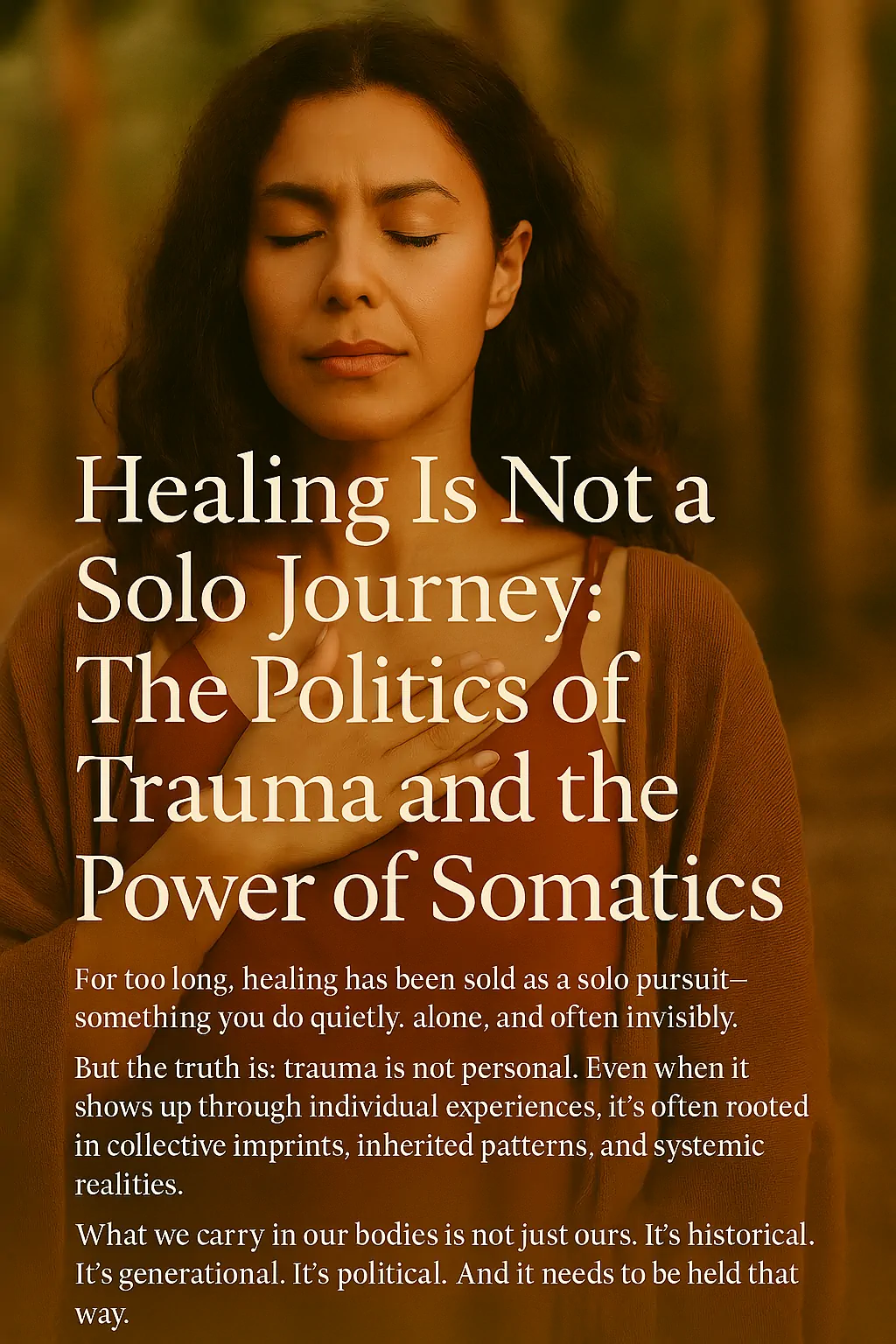
For too long, healing has been sold as a solo pursuit something you do quietly, alone, and often invisibly.
But the truth is: trauma is not personal. Even when it shows up through individual experiences, it’s often rooted in collective imprints, inherited patterns, and systemic realities.
What we carry in our bodies is not just ours. It’s historical. It’s generational. It’s political. And it needs to be held that way. Healing has been commodified and individualized in a way that isolates the very people who most need connection. In a world that glorifies independence, the myth of “healing yourself by yourself” has caused many to feel ashamed when they can’t simply meditate, journal, or affirm their way into wholeness. But when we pause and really feel into it, we realize: our nervous systems were shaped in relationship and they also heal in relationship. To carry what generations before us couldn’t speak or feel and then expect ourselves to “get over it” alone is not only unrealistic it’s deeply unjust.
I came across the work of Staci K. Haines, a pioneer in Somatics and social justice, when I was seeking answers that therapy alone couldn’t provide.
Her work cracked something open in me. She wrote, “The body is shaped by and holds social conditions.” And suddenly, so many of my clients’ emotional blocks made sense.
The perfectionism. The burnout. The fear of being seen. The deep-rooted shame that had no clear origin. These weren’t just individual pathologies they were adaptations to oppressive systems.
Staci Haines’ work is a revelation for anyone doing embodied healing. When we understand that the body carries not just personal trauma but the very imprints of patriarchy, white supremacy, capitalism, and many dogmas we stop seeing ourselves as flawed and begin seeing the brilliance of our body’s survival strategies. That shame? It’s not just yours. That chronic pushing and proving? It’s not a failure it’s a response. Somatic work helps decode the why behind our pain and it returns us to the dignity that was stripped away by systems that told us who we should be, rather than who we truly are. Trauma doesn’t live in the mind it lives in the body.
And so does our resistance. So does our resilience. And if we want to heal, we have to include the body.
Not just as a support system but as the starting point. You cannot think your way out of a trauma that was stored in the tissues. The very sensations, reflexes, and responses that rise in stress tight chest, frozen voice, clenched jaw, urge to flee are not random. They are encoded maps of your lived experience. Resilience is not just about bouncing back it’s about learning how to listen, how to relate to the body differently. When we start there, healing becomes a return to our original intelligence. It becomes a reconnection with the body not as something to fix but something to finally hear.
In my own practice, I’ve witnessed how trauma is shaped not only by personal experiences but by the conditions we are born into patriarchy, colonialism, racism, capitalism.
This isn’t just philosophy. It’s lived reality.
And the nervous system adapts. It contracts, dissociates, or over functions in environments that deny safety, connection, and dignity. When we were children and our caregivers were under the weight of their own inherited trauma, we learned quickly: be good, be quiet, be small. For some, being invisible was safe. For others, overachieving or people-pleasing became survival. These patterns didn’t form because we were weak. They formed because we were brilliant. The body adjusted to meet the unspoken demands of unsafe spaces. And now, as adults, we’re being asked to undo these adaptations but without shame. With reverence.
Staci Haines invites us into the understanding that somatics is not only a healing modality it is a political act.
To reclaim the body, to allow ourselves to feel, to move from freeze to flow, to choose connection when isolation was safer this is resistance.
This is reclamation. This is the beginning of change. Choosing to feel is radical. Choosing to slow down in a productivity-obsessed world is revolutionary. Choosing to rest, to be with your grief, to say “no more” to inherited silence that is activism of the soul. Somatic work becomes more than healing. It becomes how we interrupt harmful cycles. It becomes how we say: I am no longer available to carry what was never mine, and I am willing to be with what is. That choice creates ripples through our relationships, our work, our lineage.
Healing cannot be separated from context.
If a woman is healing from overgiving in her relationships, we must look at the systems that taught her that her worth depends on her service.
If a man is healing from emotional suppression, we must address the conditioning that told him feeling is weakness.
If a child grows into an adult who fears rest, we must question the pace of a society that equates stillness with laziness. This is not about blame. It’s about context. When we know the water we’ve been swimming in, we stop blaming the fish for not breathing. A woman’s exhaustion is not just hers it is a reflection of centuries of being taught to nurture everyone but herself. A man’s detachment is not failure—it’s a result of being taught not to cry, not to soften, not to need. Somatics gives us a new lens. It asks: “What did this adaptation help you survive?” And from there, we can offer choice, not shame.
We heal not just to “fix” ourselves, but to stop the transmission of untruths within our families, our workplaces, our communities.
Every time we choose to feel instead of flee, to speak instead of suppress, to pause instead of perform we stop a pattern. Every time we parent ourselves or our children with presence instead of punishment, we rewrite a legacy. Somatics doesn’t ask us to do this alone it asks us to do it together. With others. With guidance. With tools. With breath. With the body as our map.
And this is where somatics becomes so powerful.
Because it is not just about insight it is about practice.
It’s about learning how to feel safe enough in the body to interrupt the survival response.
It’s about creating new patterns, not just mentally but physically, emotionally, and relationally.
In somatic healing, we don’t just talk we move. We breathe. We feel. We become the new pattern through practice, not performance.
➡️ You can read every book and still find yourself stuck in the same emotional cycle. That’s because healing happens through doing. Through sensing. Through risking new ways of being. That’s the power of somatic work it’s not just about what you know. It’s about how you relate to your breath when you’re triggered. How you move your body when fear rises. How you stay when your instinct is to leave. It’s subtle. But it’s sacred. This is embodied change.
If you’ve been on a healing path that feels lonely, or like you’re the one “broken,” I want you to know this:
You are not broken. You are shaped.
And what has been shaped can be reshaped.
But we can’t do it alone.
➡️ So many women carry quiet shame that their nervous system is “too much.” That their breakdowns mean failure. That their anxiety means they’re weak. But trauma isn’t who you are it’s what happened to you. And somatic work shows us: if the body adapted once, it can adapt again. This time toward safety, connection, and expansion.
We need spaces where we are seen not as problems to solve, but as humans to reconnect.
We need guides who understand both the nervous system and the nervous system’s history.
We need practices that don’t bypass the body, but return us to it.
➡️ Spaces of healing must hold the whole truth not just about the person, but about the systems that shaped them. This is what makes the work sacred. And sustainable. When you’re seen as more than your symptoms when someone can hold your rage, your silence, your grief, your joy you become free to feel again. And that changes everything.
This is the work I offer. Not quick fixes. Not bypassing.
But a space where your healing is not extracted from your life it’s grounded in it.
This is not self-help. This is self-honoring. This is remembering that your healing matters not just for you, but for everyone who comes after you. This is body-led liberation. Quiet revolution. Nervous system reclamation.
If you’re a woman who is tired of repeating patterns that never came from you.
If you know your body holds wisdom that’s been suppressed for too long.
If you’re ready to reconnect with your truth, your breath, your legacy.
Then I invite you to explore what somatics can do, not just for your nervous system, but for the reclamation of your life.
Because healing is not a solo journey.
It’s a return to self, to connection, to the collective truth that we were never meant to survive alone.