By Marina Savic Baines | Nervous System Energetics™
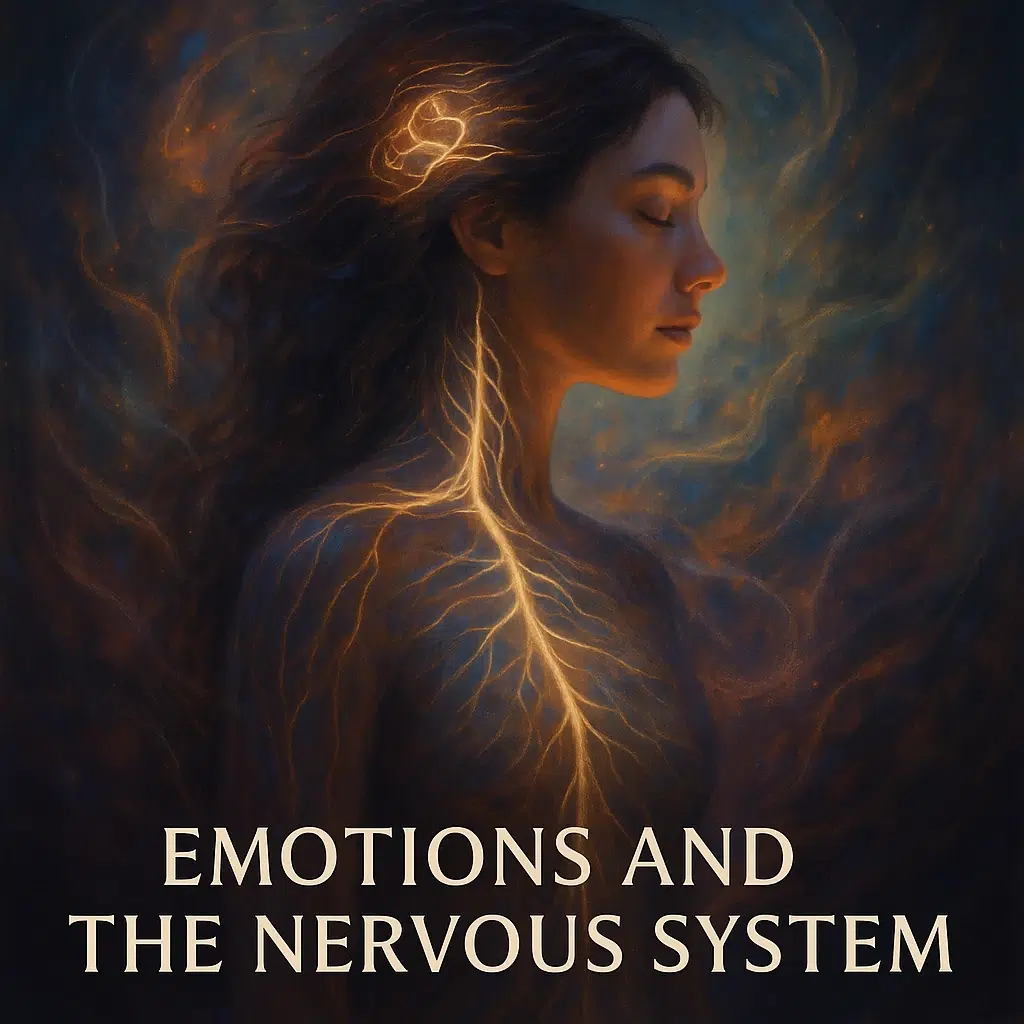
Every heartbeat, every breath, every subtle emotion you feel is part of a conversation between your body and your nervous system. This communication is ancient and intelligent. It defines how you think, how you love, how you respond to life. The nervous system and emotions are not separate entities. They are partners in a delicate, ongoing dance shaping the story of how you experience being human.
From the light flutter in your stomach when you’re excited to the heaviness in your chest when you grieve, emotions speak through biology. They live in your tissues, your pulse, your muscles, and your breath. And when we begin to understand this profound relationship not only intellectually, but through experience we begin to reclaim our power to self-regulate, heal, and create from inner coherence rather than survival.
The Nervous System: The Architecture of Experience
The human nervous system is a masterpiece of design a living communication network connecting the mind, body, and environment. It’s not only the command center that drives physical function but also the foundation of our emotional and energetic reality.
At its core lies the central nervous system, composed of the brain and spinal cord, which processes and interprets every internal and external signal. Surrounding it is the peripheral nervous system, a vast web of nerves that extends into every organ, tissue, and cell. Within this network is a branch called the autonomic nervous system, which operates beneath conscious awareness. It regulates heartbeat, digestion, hormones, and all the rhythms that keep us alive.
The autonomic system has two main branches: the sympathetic and parasympathetic. The sympathetic is our accelerator it mobilizes energy for action, vigilance, and protection, preparing the body for “fight or flight.” The parasympathetic is our brake it restores balance through the “rest and digest” functions. The harmony between these two creates the foundation for emotional stability, creativity, and overall vitality.
The Emotional Brain: How We Feel What We Feel
Emotions are not abstract concepts; they are physical processes. They arise from an intricate system within the brain called the limbic system, often referred to as the emotional brain. This region includes the amygdala, which detects emotional significance and triggers protective responses; the hippocampus, which stores emotional memory; and the prefrontal cortex, which interprets and regulates emotional impulses.
When we experience joy, fear, or love, these structures coordinate in milliseconds, communicating with the body through chemical messengers and nerve signals. The heart beats faster, muscles tense, breathing shifts the body literally becomes the stage on which emotions play their part.
A regulated nervous system allows the emotional brain to move fluidly through experiences to feel deeply, process effectively, and return to balance. But when this system becomes overstimulated or chronically dysregulated, emotions loop in survival patterns. We begin to react instead of respond. The body forgets what calm feels like.
The Body’s Messengers: Neurotransmitters and Hormones
Behind every emotional state is a biochemical landscape. The body’s language of emotion is transmitted through neurotransmitters and hormones, which carry information across the nervous system.
When you feel motivated and focused, dopamine is at work. When you feel safe and connected, oxytocin flows. Serotonin stabilizes mood, while norepinephrine heightens alertness and attention. These chemicals are like an orchestra when in harmony, they create balance and vitality. But under chronic stress, this harmony becomes dissonant.
Adrenaline and cortisol, the primary stress hormones, flood the body too often. What should be a temporary response becomes a baseline. Over time, this constant activation drains the system, leading to burnout, anxiety, sleep disturbance, and emotional exhaustion.
This is why true regulation begins in the body. When the nervous system is safe, the chemistry of the body changes and emotions begin to flow instead of stagnate.
The Two-Way Communication Between Emotions and the Body
Emotions don’t only arise from the brain they are shaped by feedback from the body itself. Every emotional state has a physiological signature. Fear tightens the diaphragm and speeds up the heart. Grief contracts the chest. Joy expands the body and deepens the breath.
This is a two-way relationship: the nervous system influences emotion, and emotions influence the nervous system. Chronic stress or unresolved emotion can alter neural pathways, changing the body’s baseline of safety. What once was a natural moment of protection becomes a constant state of vigilance.
This ongoing loop explains why emotional patterns can become so deeply ingrained. The body learns them. The good news? The body can also unlearn them. Through practices that regulate the nervous system breathwork, movement, and awareness we can rewrite the story.
Interoception: The Art of Feeling from Within
Interoception is your body’s inner sense the ability to perceive internal sensations like heartbeat, hunger, tension, or calm. It’s the bridge between your physiology and your awareness.
When interoceptive awareness is strong, you can feel emotions as they emerge and respond consciously. When it’s weak, emotions seem to take over without warning. Developing interoceptive intelligence means tuning into the body’s signals before they become overwhelming sensing anxiety as tightness in the chest or recognizing exhaustion before burnout.
Somatic practices enhance this skill. By learning to feel your inner landscape with curiosity instead of judgment, you strengthen emotional intelligence and nervous system resilience. The body begins to trust that it’s safe to feel again.
The Vagus Nerve: The Body’s Pathway to Calm
One of the most extraordinary discoveries in neuroscience is the importance of the vagus nerve, a long cranial nerve that connects the brain to the heart, lungs, and digestive organs. It serves as a biological bridge between mind and body, transmitting 80% of its information from the body to the brain not the other way around.
When the vagus nerve is active and healthy, it signals safety, slows the heart rate, and releases calming neurotransmitters. This is known as vagal tone, and it’s one of the most important indicators of emotional and physical well-being.
You can strengthen vagal tone through breathwork, humming, slow exhalations, gentle movement, and emotional connection. These practices tell your brain: I am safe. And when the brain believes it, the entire system shifts toward balance and restoration.
Neuroplasticity: Rewiring the Emotional Brain
Your brain is not fixed; it’s plastic constantly changing based on your experiences. Every thought, breath, and emotional reaction lays down neural pathways. Over time, these pathways form the emotional patterns that shape your personality and worldview.
Chronic stress reinforces the circuits of fear and tension, while consistent regulation builds circuits of peace and trust. Each moment you choose awareness over reaction, presence over pressure, you’re literally rewiring your nervous system toward coherence.
This is the foundation of transformation in Nervous System Energetics™: the understanding that you can train your body to live in a state of safety, creativity, and expansion. Healing isn’t about erasing emotion it’s about teaching the nervous system to stay open while feeling.
The Somatic Path to Emotional Regulation
Somatic work is not simply a practice it is a remembering.
It is the body’s way of returning home to itself after years, even lifetimes, of suppressing its truth.
Through somatic practices, we don’t seek to control the body but to listen to it.
Each breath becomes a messenger, each movement a conversation, each still moment a sacred recalibration between the human and the divine intelligence that animates us.
When we breathe consciously, we do more than inhale air we invite life back into the spaces that once collapsed under the weight of unprocessed emotion. We awaken the vagus nerve, sending waves of safety through the system, reminding the body that it is no longer in danger.
When we move mindfully, we allow the fascia to unwind stories stored in its fibers grief, rage, shame, love energy that never had a voice, finally given permission to speak through sensation.
And when we enter stillness, we activate a different kind of movement an invisible one where the body reorganizes its energy, integrating the shifts and restoring coherence between all systems.
Somatic regulation is not about doing more but allowing more. It is the art of clearing the old frequencies that once anchored us in survival old emotions, cellular memories, inherited responses and creating space for new patterns of being to emerge.
The body, once seen as the battlefield, becomes the bridge. It learns that safety is not the absence of challenge, but the capacity to remain open within it.
This is how emotional freedom begins not by escaping intensity, but by meeting it with awareness.
Because emotions, when felt fully, transform themselves. They move through, rather than live within. They become energy once again available for creation, not contraction.
Somatic work is how the nervous system learns to trust life again, and in that trust, all systems emotional, hormonal, energetic begin to harmonize.
It is not about suppression, but expansion.
Not about control, but communion.
Not about fixing the self, but remembering the wholeness that was never lost only hidden beneath layers of tension, fear, and forgetting.
The Higher Self as the True Mentor
As the nervous system begins to find balance, something extraordinary happens the voice of the higher self begins to awaken within.
This is not a voice of noise or urgency. It speaks in silence, in knowing, in calm conviction. It is the quiet intelligence that has always lived inside you, beneath the chaos of the mind.
The higher self is not an abstract spiritual concept it is your most coherent state of being. It is the awareness that watches without judgment, the essence that remembers who you were before conditioning taught you to disconnect.
When the body feels safe, this awareness becomes embodied. It is no longer just intuition; it becomes a lived, sensory experience a state of inner guidance that radiates through your cells.
From this space, decisions are not made from fear but from alignment.
Action no longer drains energy it generates it.
The higher self directs the system from regulation, not reaction.
When you create from this state, life itself becomes synchronistic. The nervous system is no longer fighting the flow it is part of it.
You move with life rather than against it, led by a rhythm that feels effortless, clear, and deeply true.
This is the evolution of human consciousness not to transcend the body, but to integrate its wisdom so fully that spirit and matter become one.
The nervous system becomes the bridge between heaven and earth, between higher knowing and physical experience.
And in that union, life stops being a series of reactions to survive. It becomes a conscious expression of your essence.
You are no longer ruled by emotion; you are guided by energy.
You are no longer searching for meaning; you are living as it.
Your higher self was never far away.
It was simply waiting for your nervous system to slow down enough to hear it whisper:
“You were never broken. You were only waiting to remember.”